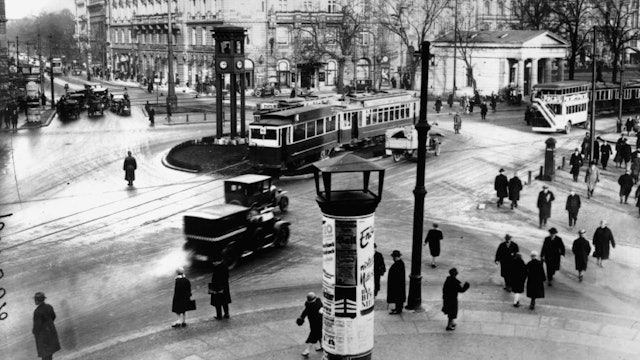

German Movies
German cinema changed the way we look at the world. In the 1920s its distorted shadows, crooked sets and hollow faces invented a language that cinema still uses today: expressionism. Since then Germany has never stopped telling, with rigor and vision, the obsessions, fears and contradictions of a difficult century.
In this category you'll find silent masterpieces, great city symphonies, fantastic tales and stories of people crushed by society, up to the directors who brought German film back to the centre of the European stage. Alongside the classics there are lesser-known authors to discover, who carry on the same tradition of severe gaze and endless curiosity.
It is a cinema that asks for attention and repays it with images you won't forget. If you want to understand where a huge part of modern cinema comes from, start here.

-
The Cabinet of Dr. Caligari
Movie
Horror, fantasy, by Robert Wiene, Germany, 1920.
The symbolic film of cinematic expressionism. Francis tells a story to a man: in 1830, in a small town, a guy named Caligari, plays the barker at the fair to present the attraction of him, a sleepwalker that he holds under hypnosis in a coffin. The... -
 Movie
Nosferatu
Movie
When a young real estate agent, Thomas Hutter, goes to the castle to close a deal, Orlok is attracted by his blood and decides to follow him to his hometown. The arrival of the count causes a series of mysterious deaths and spreads panic among the inhabitants.
Murnau, through evocative images an...
-
 Movie
Faust
Movie
Horror, by F. W. Murnau, German, 1926.
Faust is an elderly scholar who has lost faith in life. He is defeated by his inability to help others and by his awareness of his own mortality. One day, he meets Mephistopheles, who offers him a pact: in exchange for his soul, Mephistopheles will give him ... -
 Movie
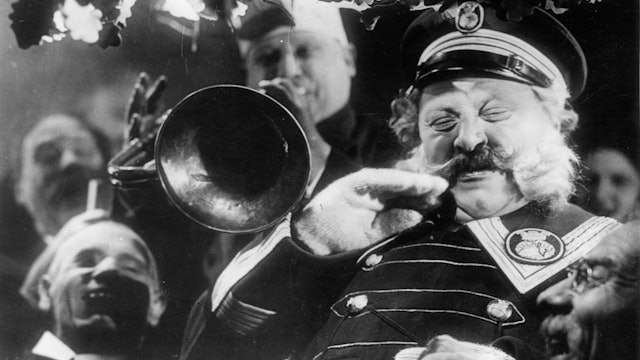
The Last Laugh
Movie
Drama, by F.W. Murnau, Germany, 1924.
Jannings is the doorman of the Atlantic hotel in Berlin, happy with his role and his uniform. But his boss thinks he is too old to receive customers at the entrance and sets him up to clean the bathrooms. Jannings, deeply troubled by what happened, gets drunk... -
 Movie
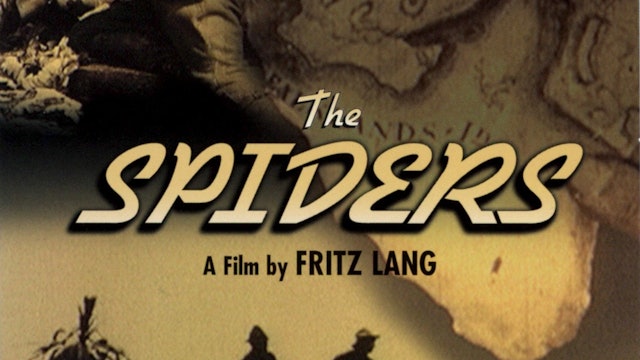
The Spiders
Movie
Adventure, by Fritz Lang, Germany, 1919.
In San Francisco, Kay Hoog tells friends at her club that she found a message in a bottle. Inside is a map drawn by a missing man, a well-known Harvard professor. The message tells of a lost Inca civilization that possesses an immense treasure.Food for t...
-
Berlin: Symphony of a Metropolis
Movie
Documentary, by Walter Ruttmann, Germany, 1928.
One of the most important avant-garde films of the "city symphony" genre, inspired by Dziga Vertov's "The Man with the Camera" and Soviet editing theories. The film marks the passage of the artist Walter Ruttmann from abstract cinema to reality cine... -
Sunrise: A Song of Two Humans
Movie
Drama, romance, noir, by Friedrich Wilhelm Murnau, United States, 1927
A big-city woman on vacation (Margaret Livingston) stays in a small lakeside town. After dark she goes to a farm where the man (George O'Brien) and his wife (Janet Gaynor) are looking after their child. She calls to the man fr... -
 Movie
Vampyr
Movie
Horror, by Carl Theodor Dreyer, Germany, 1932.
Late in the evening, Allan Gray arrives at an inn near the town of Courtempierre and rents a room to sleep. Gray is suddenly disturbed by an old man, who enters the room and leaves a square package on the table: "To be opened on my death" is written ...